Kommentierte Besichtigung der Kirche St. Martin
Gegenüber den Pyrenäen befinden sich die Kirche Saint-Martin und der umliegende Friedhof auf einem Motte, gekrönt von einer kreisförmigen Mauer. Diese Bestimmung hat den Eindruck erweckt, dass es ursp
Conditions
Visite gratuite sans condition.
© Antoine Torres
Gegenüber den Pyrenäen befinden sich die Kirche Saint-Martin und der umliegende Friedhof auf einem Motte, gekrönt von einer kreisförmigen Mauer. Diese Anordnung ließ vermuten, dass es ursprünglich eine Schutzanlage (12.-13. Jahrhundert) gab. Wie ein Donjon endet der hohe Glockenturm, der aus der Ferne sichtbar ist, in einer Kammer mit fünf Glockentürmen.
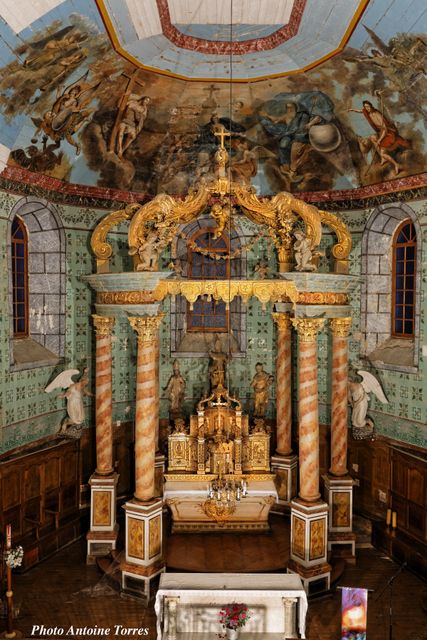
Die Kirche selbst stammt aus dem 16. bis 17. Jahrhundert. Im Inneren kann man Statuen aus dem siebzehnten Jahrhundert in vergoldetem und vielfarbigem Holz sehen, die von einem verschwundenen Altarbild erhalten sind. Der barocke Hochaltar und sein Tabernakel sind das Werk des bigordan Bildhauers Marc Ferrère aus dem 18. Jahrhundert, der Baldachin ist das Werk seines Sohnes Dominique. An der Decke des Chores bedeckt ein prächtiges monumentales Gemälde aus dem 18. Jahrhundert fast die gesamte Breite der Kirche. Im Kirchenschiff befinden sich vier große Gemälde mit Werken berühmter Maler des 17. Jahrhunderts: Louis de Boullongne, Jean-Baptiste Jouvenet, Pierre Mignard und Guido Reni. Der Altar, das Tabernakel und das Baldachin sind als historische Denkmäler klassifiziert, die Kirche ist als historisches Denkmal eingetragen.
Die Besichtigung ist kostenlos oder kann von ehrenamtlichen Gästen, die sich für Barockkunst begeistern, kommentiert werden.
Guided tour of the Church of Saint Martin
Facing the Pyrenees, the church of Saint Martin and the cemetery that surrounds it are located on a clod crowned by a circular wall. This layout made us think that originally there was an enclosure in
Conditions
Visite gratuite sans condition.
© Antoine Torres
Facing the Pyrenees, the church of Saint Martin and the cemetery that surrounds it are located on a clod crowned by a circular wall. This layout made us think that originally there was a defensive enclosure (XII-XIIIth centuries). Like a dungeon, the high steeple, visible from afar, ends in a chamber of bells with corbeling of five steeples.
The church itself dates from the 16th-17th centuries. Inside you can see statues of the seventeenth century in gilded and polychrome wood remaining from a vanished altarpiece. The Baroque high altar and tabernacle are the work of an 18th century sculptor from Bigorre, Marc Ferrère, and the canopy is that of his son Dominique. On the ceiling of the choir a magnificent monumental painting of the eighteenth century covers almost the entire width of the church. In the nave, four large paintings depicting works by famous 17th-century painters: Louis de Boullongne, Jean-Baptiste Jouvenet, Pierre Mignard, and Guido Reni. The altar, the tabernacle, and the canopy are classified as historical monuments; the church is listed as a historic monument.
The visit is free or can be commented by volunteers passionate about baroque art.
Visita commentata della chiesa di San Martino
Di fronte ai Pirenei, la chiesa di San Martino e il cimitero che lo circonda sono situati su una motte coronata da un muro circolare. Questa disposizione ha fatto pensare che in origine c'era un recin
Conditions
Visite gratuite sans condition.
© Antoine Torres
Di fronte ai Pirenei, la chiesa di San Martino e il cimitero che lo circonda sono situati su una motte coronata da un muro circolare. Questa disposizione ha fatto pensare che in origine vi fosse un recinto difensivo (XII-XIII secolo). Come un dungeon, l'alto campanile, visibile da lontano, termina con una camera delle campane a incastro con cinque campanili.
La chiesa stessa risale al XVI-XVII secolo. All'interno si possono vedere statue del XVII secolo in legno dorato e policromo che sopravvivono da un retablo scomparso. L'altare maggiore e il tabernacolo barocchi sono opera di uno scultore bighurdan del XVIII secolo, Marc Ferrère, mentre il baldacchino è opera di suo figlio Dominique. Sul soffitto del coro un magnifico dipinto monumentale del XVIII secolo copre quasi tutta la larghezza della chiesa. Nella navata, quattro grandi quadri raffiguranti opere di famosi pittori del XVII secolo: Louis de Boullongne, Jean-Baptiste Jouvenet, Pierre Mignard, Guido Reni. L'altare, il tabernacolo e il baldacchino sono classificati monumenti storici, la chiesa è iscritta monumento storico.
La visita è libera o può essere commentata da volontari appassionati di arte barocca.
Visite commentée de l'église Saint-Martin
Face aux Pyrénées l’église Saint Martin et le cimetière qui l’entoure sont situés sur une motte couronnée d’un mur circulaire. Cette disposition a fait penser qu’à l’origine il y avait là un enclos à…
Conditions
Visite gratuite sans condition.
© Antoine Torres
Face aux Pyrénées l’église Saint Martin et le cimetière qui l’entoure sont situés sur une motte couronnée d’un mur circulaire. Cette disposition a fait penser qu’à l’origine il y avait là un enclos défensif (XII-XIIIème siècles). Tel un donjon le haut clocher, visible de loin, se termine par une chambre des cloches à encorbellement à cinq clochetons.
L’église elle-même date des XVIème-XVIIéme siècles. A l’intérieur on peut voir des statues du XVIIème siècle en bois doré et polychrome subsistant d’un retable disparu. Le maître-autel et son tabernacle baroques sont l’œuvre d’un sculpteur bigourdan du XVIIIème siècle, Marc Ferrère, et le baldaquin celle de son fils Dominique. Au plafond du chœur une magnifique peinture monumentale du XVIIIème siècle couvre presque toute la largeur de l’église. Dans la nef, quatre grands tableaux reprenant des œuvres de peintres célèbres du XVIIème siècle: Louis de Boullongne, Jean-Baptiste Jouvenet, Pierre Mignard, Guido Reni. L'autel, le tabernacle et le baldaquin sont classés monuments historiques, l'église est inscrite monument historique.
La visite est libre ou peut être commentée par des bénévoles passionnés d'art baroque.
Visita comentada de la iglesia de San Martín
Frente a los Pirineos, la iglesia de San Martín y el cementerio que lo rodea están situados en una buconera coronada por un muro circular. Esta disposición hizo pensar que originalmente había un recin
Conditions
Visite gratuite sans condition.
© Antoine Torres
Frente a los Pirineos, la iglesia de San Martín y el cementerio que lo rodea están situados en una buconera coronada por un muro circular. Esta disposición hizo pensar que originalmente había un recinto defensivo (siglos XII-XIII). Como un torreón, el campanario alto, visible desde lejos, termina en una cámara de campanas encorbelladas con cinco campanarios.
La iglesia misma data de los siglos XVI-XVII. En el interior se pueden ver estatuas del siglo XVII de madera dorada y policromada que subsisten de un retablo desaparecido. El altar mayor y su tabernáculo barrocos son la obra de un escultor bighurdan del siglo XVIII, Marc Ferrère, y el baldaquino la de su hijo Dominique. En el techo del coro una magnífica pintura monumental del siglo XVIII cubre casi toda la anchura de la iglesia. En la nave, cuatro grandes cuadros que reproducen obras de pintores famosos del siglo XVII: Louis de Boullongne, Jean-Baptiste Jouvenet, Pierre Mignard, Guido Reni. El altar, el tabernáculo y el baldaquín están clasificados como monumentos históricos, la iglesia está inscrita como monumento histórico.
La visita es libre o puede ser comentada por voluntarios apasionados del arte barroco.


