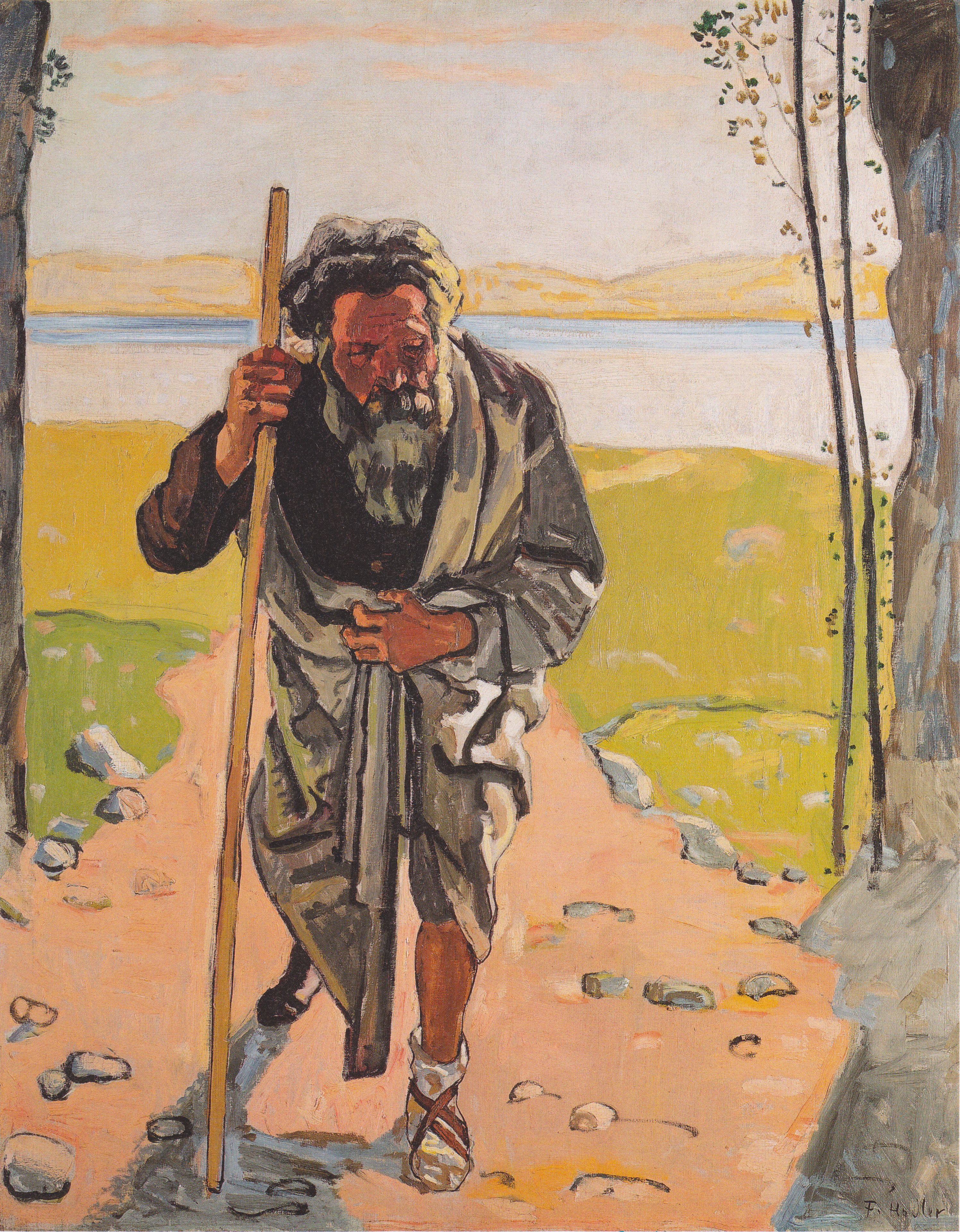
Ferdinand Hodler, "Le Juif errant", 1886, huile sur toile, 104,5 x 81,5 cm, signé en bas à droite : "Hodler", Winterthour, Kunst Museum, Stiftung Oskar Reinhart, achat, 1931.
Aren’t we all travelers in this world?
So say the sacred texts and many ancient legends… The Wandering Jew, that tireless pilgrim, is the most famous traveler in our world. He is the man who is always on the move, knowing only one thing: one day he will be set free.
In 1856, Gustave Doré created twelve splendid engravings based on the legend of the Wandering Jew, which quickly caused a sensation in artistic circles. His brother Ernest was immediately inspired to compose music for them, and Pierre Dupont, a romantic singer-songwriter, wrote a long poem in twelve cantos, incorporating a thousand details from the engravings. Together, they published these works in a giant-format book. Today, the Compagnie La Renaissance draws on the content of this book to create a performance featuring the engravings, the song, and the poem recited by Lydia Weyrich. Accompanied by Gabriel Esteban on the cello and Eloïse Fares on the harp, musical pieces by Beethoven, Saint-Saëns, Bartók, Crumb, Gounod, and from the Jewish folk repertoire serve as the backdrop for this performance, highlighting the emotional states of the tireless pilgrim.
This performance is presented at the Museum of the Reformation as part of the exhibition “Ferdinand Hodler: Profession of Faith,” in conjunction with the painter’s work *The Wandering Jew*—on loan from the Winterthur Museum—and the Bible illustrated by Gustave Doré, which is on display there for the occasion. It has been performed at the Alexis-Forel Museum in Morges, the Abbatiale in Romainmôtier, and the Engelberts Foundation in Mies.


