Exhibition "Grandad, tell me why the trees cry?"
A contemporary journey through the history of rubber, from Bordeaux to the West Indies via Taiwan, where industrial and environmental histories intertwine with the personal narrative of Simon Gabourg.
25 September - 1 November
This event includes accessibility accommodations
Motor impairment
Simon Gabourg
Simon Gabourg explores buried memories and the traces left behind by commercial and industrial systems.
An artist born in Pointe-à-Pitre who graduated from the Bordeaux School of Fine Arts in 2022, he explores the diversity of cultural, economic, social and political currents that run through our contemporary societies. He seeks to create new alternative narratives, myths and original forms, drawing on the remnants of materials and technical objects steeped in history.
Stories in which other forms of life and resilience coexist, and where fragments of the past nourish the worlds to come.
Following an initial phase of his work devoted to the wood palette, Simon Gabourg is now exploring a new direction centred on rubber, taking as his starting point the port of Bordeaux and the River Garonne – regions steeped in a rich industrial and commercial heritage.
Bordeaux, a strategic port in the rubber trade, serves as a starting point for a discussion on industrialisation, the exploitation of natural resources (rubber trees) and the environmental issues involved.
Supported by Zébra3 and the Bordeaux Métropole Archives * over a period of several months as part of a research and creative residency, the project is rooted in specific locations in Bordeaux, whilst also extending to Taiwan and the Caribbean, thanks to a network of partners, and highlights the intersections between memory, industrial infrastructure and ecological transformations.
Behind this material lie intertwined stories of plantations, transport, wars and displacement. Rubber has been as much a part of industrial expansion as it has been of human journeys, linking distant territories, colonial economies, landscapes, infrastructure and bodies put to work.
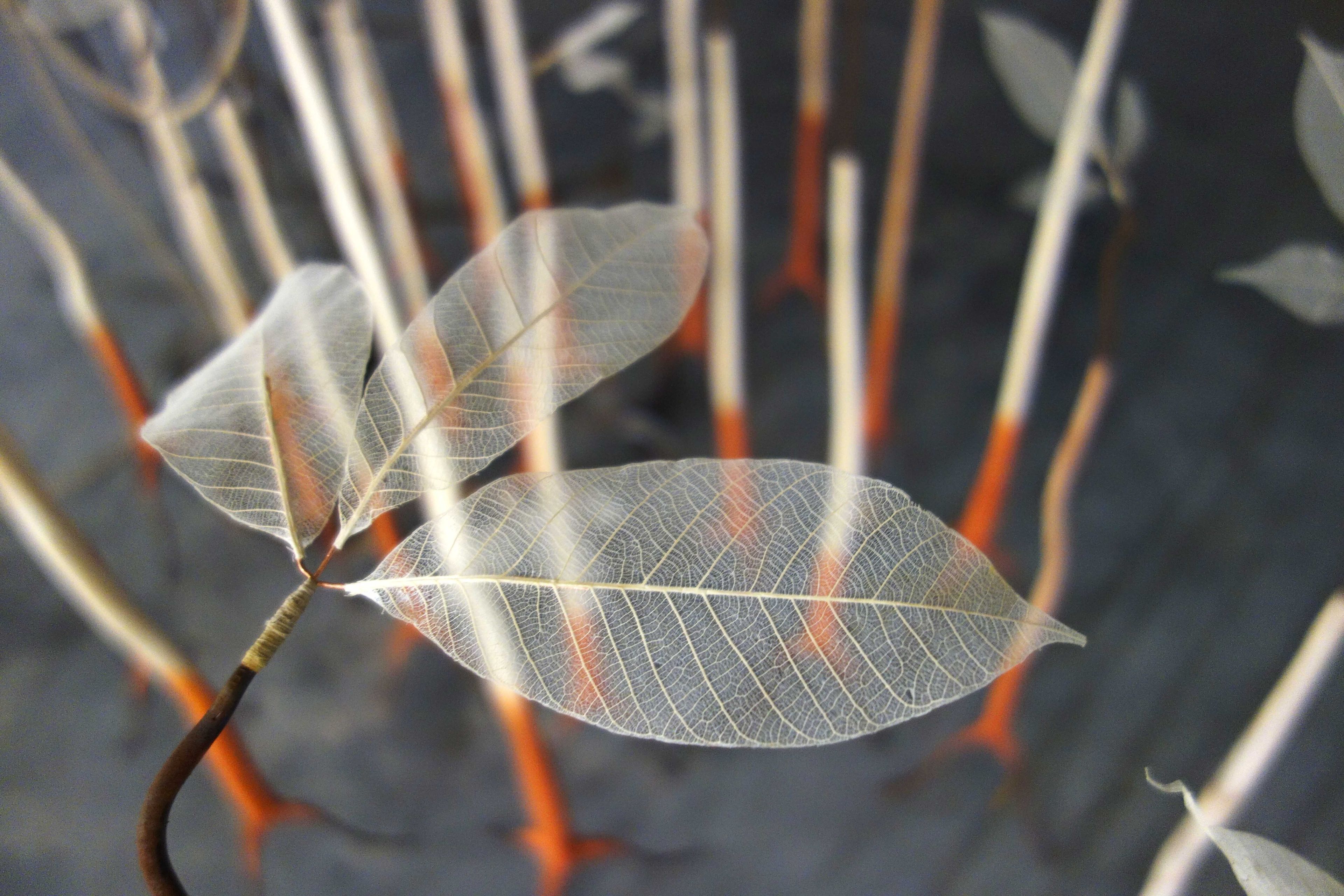
In the exhibition, forms sometimes seem to be growing, and at other times crumbling. Wood, metal, rust and weathered materials coexist like the remnants of a changing landscape. Something continues to flow between them: residues, energy, a slow intermingling between the living and our ways of being in the world.
In the background lingers the echo of a departure for Indochina – that of his grandfather, who came from Martinique – caught up in a wider history in which rubber, machinery and conflicts were already rife. Materials extracted, worn down and moved from one place to another, as if they continued to bear within them the lingering traces of a history.
Different eras seem to layer upon one another: the slow pace of trees and growth; the more abrupt rhythm of colonial exploitation and trade; the era of wars and industrialisation; but also the uncertain era of ruins, remnants and the transformations yet to come.
The title poses a simple, almost childlike question: Why do trees weep?
Perhaps because they remember. Perhaps because they continue to bear fruit despite their wounds. Perhaps also because the line between living things and man-made objects has never been entirely clear-cut.
exhibition, free, contemporary art, history, free tour
Exposition "Papi, dis-moi pourquoi les arbres pleurent ?"
Une traversée contemporaine de la mémoire du caoutchouc, de Bordeaux aux Antilles en passant par Taïwan, où se mêlent histoires industrielle, écologique et récit intime de l'artiste Simon Gabourg.
25 September - 1 November
This event includes accessibility accommodations
Motor impairment
Simon Gabourg
Découvrez une exposition inédite à Bordeaux
Simon Gabourg interroge les mémoires enfouies et les traces laissées par les systèmes commerciaux et industriels. Artiste né à Pointe-à-Pitre et diplômé de l’école des Beaux-arts de Bordeaux en 2022, il explore la diversité des flux culturels, économiques, sociaux et politiques qui traversent nos sociétés contemporaines. Il propose de créer de nouveaux récits alternatifs, des mythes et des formes inédites, à partir des vestiges de matériaux et d’objets techniques marqués par l’histoire. Des récits où coexistent d’autres formes de vie et de résilience et où les fragments du passé nourrissent les mondes à venir.
Après un premier volet de son travail consacré à la palette de bois, Simon Gabourg déploie aujourd’hui un nouvel axe autour du caoutchouc, à partir du port de Bordeaux et de la Garonne, territoires porteurs d’un riche patrimoine industriel et commercial.
Bordeaux, port stratégique dans le commerce du caoutchouc, devient le point d’entrée d’une réflexion sur l’industrialisation, l’exploitation des ressources naturelles (hévéa) et leurs enjeux environnementaux.
Accompagné par Zébra3 et les Archives de Bordeaux Métropole * durant plusieurs mois sous forme d’une résidence de recherche et de création, le projet s’ancre dans des lieux spécifiques de Bordeaux, en passant par Taïwan et les Antilles, grâce à un ensemble de partenaires et met en lumière les croisements entre mémoire, infrastructures industrielles et transformations écologiques.
exposition, art contemporain, Fabrique Pola, arts plastiques, visite guidée


