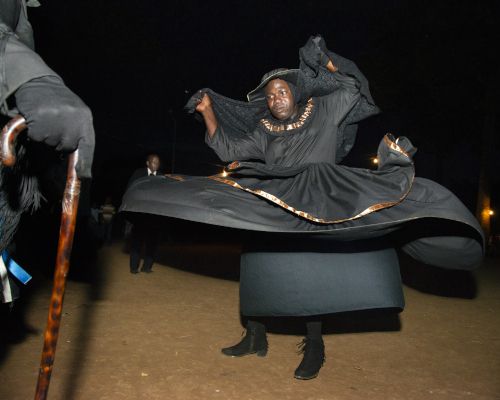
Nicola Lo Calzo, Honorio Soares, alias Simé, capitaine du groupe Danço Congo Vera Cruz. Village de Pantufo, São Tomé, Série Tragédia, 2026
Photographer, teacher and researcher, Nicola Lo Calzo holds a doctorate in arts and a master’s degree in landscape architecture. His work is at the intersection of photographic practice, historical research and queer and decolonial theories, in an approach that articulates creation, investigation and critical engagement.
His projects, often carried out in a collaborative way, question subaltern memories, forms of resistance and the processes of construction of marginalized identities. Through his visual investigations, he explores the dynamics of power, the mechanisms of exclusion and the dominant narratives of history, while contributing to the enhancement and circulation of minority archives.
Since 2010, Nicola Lo Calzo has been developing the project over the long term Kam, labeled by UNESCO, which explores the legacies of resistance to slavery and marooning (that is, the escape of slaves into the woods or mountains to escape servitude on colonial plantations) across different territories in the Atlantic area. The term "Kam," reactivated here by the artist, pays tribute to the Senegalese author Cheikh Anta Diop, who reinvests the biblical term Cham, associated with the slavery of the Africans, attaching it to Kemet, the pharaonic name of ancient Egypt, symbolically designating Africa as a place of memory and origin.
This photographic work, patiently developed over time, questions the shadows of history, not to freeze them, but to bring out tensions, survivals and transmissions. His images, taken in West Africa, the Caribbean, North America and Europe, bear witness to the persistence of memories of slavery in contemporary territories. They reveal as much marked landscapes as bodies, gestures, rituals and narratives transmitted orally. The complexity of heritages and how minority experiences can become the ferment of a common memory are here examined, tested and displaced.
Through Rebellious dances unfolds a committed work, at the crossroads of investigation and creation, where photography becomes a tool for transmission as much as a space for critical reflection on history and its representations.
Dance and body movement are at the heart of this research. For the enslaved populations, they were much more than a form of expression: vectors of memory, transmission of African heritages and resistance. Through the movement, collective solidarities were woven and identities that the slave order sought to erase. This political function of transmitting memory remains today, making dance and the body contemporary practices of resistance, memory and emancipation.
Within Rebellious dances the photographs dialogue with objects of memorial practices collected over time, books that have accompanied and inspired the artist’s research, oral testimonies, as well as a large corpus of press articles and documents constituting a veritable atlas of this research conducted over several years.
Without seeking to embrace the totality of this investigation, the exhibition proposes a form of atlas: a sensitive cartography of its trajectories, archives, questions and contemporary echoes.
An exhibition produced with the support of the Istituto italiano di cultura Strasbourg.


