Ausstellung von Fotografien und anderen Kuriositäten: Abt Paysant
Ausstellung von Fotografien und anderen Kuriositäten: Abt Paysant
© Les amis de l'église de Ménil-Gondouin
Ausstellung von Fotografien und anderen Kuriositäten: Abt Paysant
Im Jahr 1873 wurde der Abt Victor Paysant (1841-1921) zum Pfarrer von Ménil-Gondouin ernannt, obwohl der Bau der Kirche noch nicht abgeschlossen war. Umgeben von Malern und Bildhauern, führte er die Bauarbeiten zu Ende und begann ein außergewöhnliches Dekorationswerk im Inneren wie im Äußeren des Gebäudes.
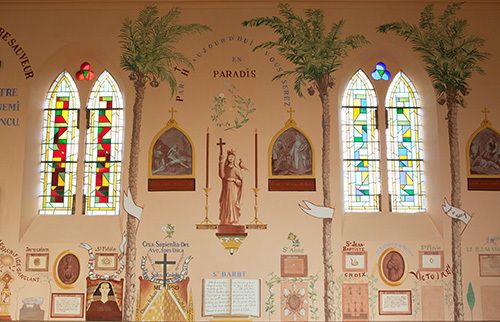
Fast 48 Jahre lang restaurierte der Abt alte Skulpturen, schuf neue, bereicherte die Möbel und überzog Böden und Wände mit heiligen Texten, gemalten oder gravierten Zitaten.
Er versteht die Kirche als ein wirkliches Werkzeug der Weitergabe, das er selbst als einen "lebendigen Katechismus" und eine "christliche Bibliothek" beschreibt, die er "die lebendige und sprechende Kirche von Menil-Gondouin" tauft.
Nach seinem Tod wurden die meisten Fresken vom Bistum gelöscht, und die Glasfenster 1944 bei den Bombardierungen zerstört. Ab 2004 ermöglichte eine umfangreiche Restaurierung, der Kirche ihr ursprüngliches Aussehen zurückzugeben und bietet den Besuchern heute ein einzigartiges Zeugnis des Glaubens, der Kunst und der lokalen Geschichte.
Exhibition of photographs and other curiosities: the abbot Paysant
Exhibition of photographs and other curiosities: the abbot Paysant
© Les amis de l'église de Ménil-Gondouin
Exhibition of photographs and other curiosities: the abbot Paysant
In 1873, the abbot Victor Paysant (1841-1921) was appointed parish priest of Ménil-Gondouin, while the construction of the church was not yet completed. Surrounded by painters and sculptors, he led the project to completion and launched an exceptional decorative work, both inside and outside the building.
For nearly 48 years, the abbot restored old sculptures, created new ones, enriched furniture and covered floors and walls with sacred texts, painted or engraved quotations.
He conceived the church as a true tool of transmission, which he himself described as a "living catechism" and a "Christian library", which he baptized "the living and speaking church of Ménil-Gondouin".
At his death, a large part of the frescoes were erased by the bishopric, then the stained glass windows were destroyed during the 1944 bombings. From 2004, a major restoration work allows to restore the church to its original appearance, offering today visitors a unique testimony of faith, art and local history.
Esposizione di fotografie e altre curiosità: l'abate Paysant
Esposizione di fotografie e altre curiosità: l'abate Paysant
© Les amis de l'église de Ménil-Gondouin
Esposizione di fotografie e altre curiosità: l'abate Paysant
Nel 1873, l'abate Victor Paysant (1841-1921) viene nominato parroco di Ménil-Gondouin, mentre la costruzione della chiesa non è ancora terminata. Circondato da operai pittori e scultori, porta a termine il cantiere e si lancia in un'opera di decorazione eccezionale, sia all'interno che all'esterno dell'edificio.
Per quasi 48 anni, l'abate restaura sculture antiche, ne crea di nuove, arricchisce l'arredamento e ricopre pavimenti e pareti con testi sacri, citazioni dipinte o incise.
Concepisce la chiesa come un vero strumento di trasmissione, che egli stesso descrive come un "catechismo vivente" e una "biblioteca cristiana", che egli chiama "la chiesa viva e parlante di Menil-Gondouin".
Alla sua morte, una gran parte degli affreschi è stata cancellata dal vescovado, poi le vetrate sono state distrutte durante i bombardamenti del 1944. A partire dal 2004, un importante lavoro di restauro permette di restituire alla chiesa il suo aspetto originario, offrendo oggi ai visitatori una testimonianza unica di fede, arte e storia locale.
Exposition de photographies et autres curiosités : l'abbé Paysant
Exposition de photographies et autres curiosités : l'abbé Paysant
© Les amis de l'église de Ménil-Gondouin
Exposition de photographies et autres curiosités : l'abbé Paysant
En 1873, l’abbé Victor Paysant (1841-1921) est nommé curé de Ménil-Gondouin, alors que la construction de l’église n’est pas encore achevée. Entouré d’ouvriers peintres et sculpteurs, il mène le chantier à son terme et se lance dans une œuvre de décoration exceptionnelle, à l’intérieur comme à l’extérieur de l’édifice.
Pendant près de 48 ans, l’abbé restaure des sculptures anciennes, en crée de nouvelles, enrichit le mobilier et recouvre sols et murs de textes sacrés, de citations peintes ou gravées.
Il conçoit l’église comme un véritable outil de transmission, qu’il décrit lui-même comme un « catéchisme vivant » et une « bibliothèque chrétienne », qu’il baptise « l’église vivante et parlante de Ménil-Gondouin ».
À sa mort, une grande partie des fresques est effacée par l’évêché, puis les vitraux sont détruits lors des bombardements de 1944. À partir de 2004, un important travail de restauration permet de redonner à l’église son apparence d’origine, offrant aujourd’hui aux visiteurs un témoignage unique de foi, d’art et d’histoire locale.
Exposición de fotografías y otras curiosidades: el abad Paysant
Exposición de fotografías y otras curiosidades: el abad Paysant
© Les amis de l'église de Ménil-Gondouin
Exposición de fotografías y otras curiosidades: el abad Paysant
En 1873, el abad Víctor Paysant (1841-1921) es nombrado párroco de Ménil-Gondouin, mientras que la construcción de la iglesia no se ha terminado todavía. Rodeado de trabajadores pintores y escultores, lleva a cabo la obra hasta su término y se lanza a una obra de decoración excepcional, tanto en el interior como en el exterior del edificio.
Durante casi 48 años, el abad restaura esculturas antiguas, crea nuevas, enriquece el mobiliario y cubre suelos y paredes con textos sagrados, citas pintadas o grabadas.
Concibe la iglesia como un verdadero instrumento de transmisión, que él mismo describe como un «catecismo vivo» y una «biblioteca cristiana», a la que bautiza «la iglesia viva y hablante de Menil-Gondouin».
A su muerte, una gran parte de los frescos fue borrada por el obispado y luego las vidrieras fueron destruidas durante los bombardeos de 1944. A partir de 2004, un importante trabajo de restauración permite devolver a la iglesia su apariencia original, ofreciendo hoy a los visitantes un testimonio único de fe, arte e historia local.

