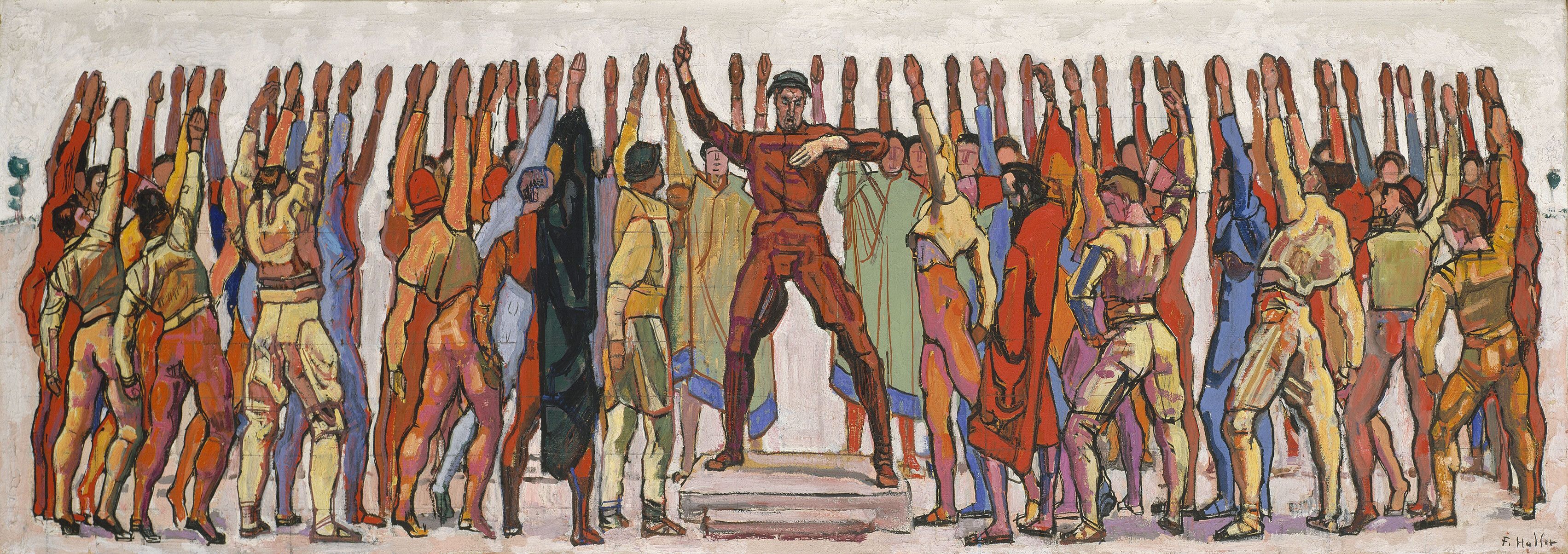
Ferdinand Hodler, "Unanimité", 1912-1913, huile sur toile, 52,5 x 163 cm, signé en bas à droite : "F. Hodler", Genève, Musée d'art et d'histoire, achat, 1939.
In 1913, Ferdinand Hodler delivered a monumental fresco to the city of Hanover depicting about a hundred citizens raising their arms in unison: *Unanimity*. Commissioned to commemorate the city’s adoption of the Reformation in 1533, the painting crystallizes a fundamental tension: the conflict, at the very heart of the Protestant heritage, between the need to express commitment through a collective gesture and the need to reconcile this with individual freedom of conscience—and the potential differences of opinion that arise from it.
The context in which this fresco was created brings to life competing legacies of liberal democracy, authoritarianism, and Jacobin democracy. Unveiled in the presence of Wilhelm II, the painting was taken down as early as 1914 following Hodler’s protest against the bombing of Reims Cathedral: this episode reveals just how much the work embodies these contradictory lineages. Did Hodler intend to depict the Reformation as a possible source of deliberative and pluralistic democracy, or was he rather offering a critique of those new forms of enforced unanimity that the 20th century would witness in the form of authoritarianism and totalitarianism?
By exploring the various ways of linking Protestantism(s), republicanism(s), and democracy(ies), this lecture will show that the Reformation did not so much give birth to democracy as it served, over the long term, as a powerful catalyst for political controversies and reflections on the meaning of majority rule. Like Hodler’s *Unanimity*, the adoption of the Reformation still retains a double-edged image today.


