IGDR Keynote Lectures - Dr. Julia Mahamid, European Molecular Biology Laboratory
In-cell structural biology at a systems level
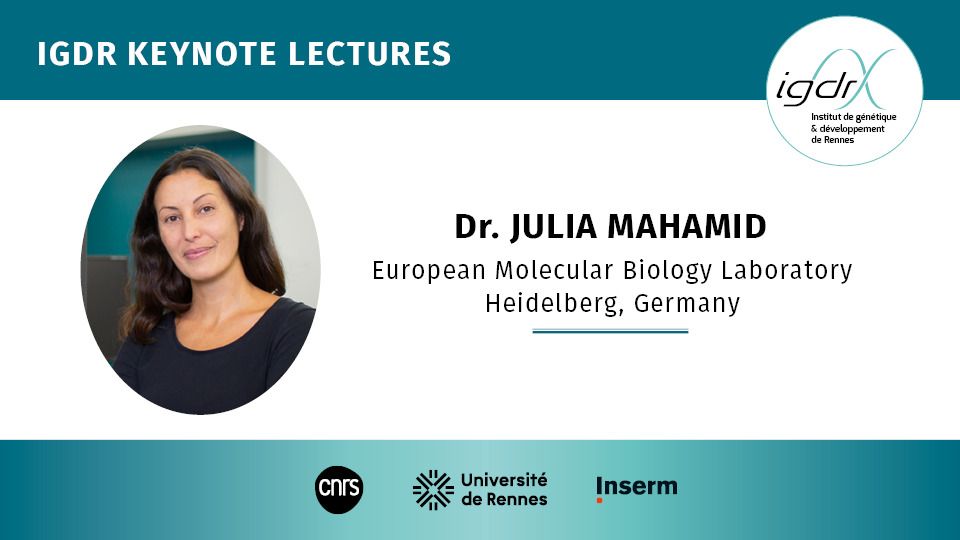
Julia Mahamid
Head of Molecular Systems Biology at European Molecular Biology Laboratory (EMBL)
Recent technological breakthroughs in cryo-electron tomography (cryo-ET) open the disruptive possibility to image macromolecular complexes in their native cellular or multicellular context at close to atomic resolution, and can directly reveal how their different conformational states and interaction networks are linked to biological functions.
We advance sample preparation techniques for in-cell cryo-ET, including cryo-focused ion beam thinning and 3D correlative (super resolution) fluorescence microscopy. Preparations of such site-specific ‘electron-transparent windows’ enable the assignment of macromolecular structures directly from the high-resolution three-dimensional stills captured by cryo-ET when aided by an array of methods, including computational patter recognition and novel developments of genetically-encoded molecular tags. Furthermore, integration of multiple data sources is key to the interpretation of the mined structural signatures.
For example, using the genome-reduced human pathogen Mycoplasma pneumoniae as a minimal cell model, we established the synergistic application of whole-cell crosslinking mass spectrometry and cellular cryo-ET to determine an in-cell integrative structural model of actively transcribing RNA polymerases coupled to translating ribosomes. Our contributions to computational methods now allow resolving these molecular machines to high resolution, reveal small molecule antibiotics bound to their active site in ribosomes within the intact pathogen, provide snapshots of their structural dynamics, and illuminate functions of previously unknown macromolecular complexes.
Such integration of cutting-edge methods unlocks an enormous potential for mechanistic understanding at a system-spanning level by in-cell structural biology.
Julia Mahamid is a structural cell biologist, specializing in cryo-electron tomography. She has just been elected a member of the German National Academy of Sciences Leopoldina.
She earned her PhD in Chemistry in 2010 from the Weizmann Institute of Science (Israel), followed by postdoctoral research at the Max Planck Institute of Biochemistry (Germany). She joined EMBL in 2017 as a group leader and became Head of the Molecular Systems Biology Unit in 2024, alongside Nassos Typas. Her pioneering work in cryo-electron tomography has enabled major breakthroughs in 3D visualization of cellular processes, particularly in studying protein synthesis and the organization of biomolecular condensates.
Research Themes
Julia Mahamid and her team focus on:
- ➠ Using cryo-electron tomography (cryo-ET) to image macromolecular complexes inside cells at near-atomic resolution, revealing how their compositional and conformational states are linked to biological functions.
- ➠ Studying supramolecular assemblies (such as biomolecular condensates) and their role in the functional organization of the cytoplasm, combining structural, cellular, and systems biology approaches.
- ➠ Integrating omics and systems biology to transform structural discoveries into mechanistic insights, in models spanning from minimal bacteria to patient-derived 3D organoids.
Awards and Distinctions
➠ Member of German National Academy of Sciences Leopoldina (2026)
➠ Leibniz Prize (2026) – Awarded by the German Research Foundation (DFG) for her outstanding contributions to in-cell structural biology.
➠ EMBO Gold Medal (2023) – For her exceptional achievements in structural cell biology and developing innovative techniques to visualize cellular machinery.
➠ Frankfurt Biophysics Prize (2022) – For her advances in high-resolution cellular imaging.
➠ Ernst Ruska Prize (2021) – For her work in cryogenic electron microscopy.
➠ ERC Starting Grant (2017) and ERC Synergy Grant (2023) – For projects on the structural understanding of cellular condensates and visual proteomics.
Download the poster
Partnership with the Life and Health Sciences doctoral school
As part of the partnership with the Life and Health Sciences doctoral school, participation in the ‘IGDR Keynote Lectures’ is included in the doctoral students' training hours at the rate of 1 hour/lecture, with a minimum attendance of three lectures.
In-cell, Structural, Biology & Cryo-electron tomography
IGDR Keynote Lectures - Dr. Julia Mahamid, European Molecular Biology Laboratory
Biologie structurale in cellulo à l'échelle des systèmes
Julia Mahamid
Responsable de l’unité de Biologie des Systèmes Moléculaires au Laboratoire Européen de Biologie Moléculaire (EMBL)
Les récentes avancées technologiques en tomographie cryo-électronique (cryo-ET) ouvrent la possibilité révolutionnaire d'imager des complexes macromoléculaires dans leur contexte cellulaire ou multicellulaire natif, avec une résolution quasi atomique. Cette approche permet de révéler directement comment leurs différents états conformationnels et leurs réseaux d'interactions sont liés aux fonctions biologiques.
Nous améliorons les techniques de préparation d'échantillons pour la cryo-ET in cellulo, notamment l'amincissement par faisceau d'ions focalisé sous cryogénie (cryo-FIB) et la microscopie de fluorescence corrélative 3D (à super-résolution). La préparation de ces « fenêtres électron-transparentes » spécifiques permet d'attribuer les structures macromoléculaires à partir des images tridimensionnelles à haute résolution capturées par cryo-ET, en s'appuyant sur une gamme de méthodes, dont la reconnaissance de motifs computationnelle et le développement de nouveaux marqueurs moléculaires génétiquement codés. Par ailleurs, l'intégration de multiples sources de données est essentielle pour interpréter les signatures structurales identifiées.
Par exemple, en utilisant le pathogène humain à génome réduit Mycoplasma pneumoniae comme modèle cellulaire minimal, nous avons combiné la spectrométrie de masse par réticulation à l'échelle cellulaire entière et la cryo-ET cellulaire pour établir un modèle structural intégratif in cellulo des ARN polymérases en cours de transcription, couplées à des ribosomes en traduction. Nos contributions aux méthodes computationnelles permettent désormais de résoudre ces machines moléculaires à haute résolution, de révéler des antibiotiques de petite taille liés à leur site actif dans les ribosomes au sein du pathogène intact, de capturer des instantanés de leur dynamique structurale et d'élucider les fonctions de complexes macromoléculaires jusqu'alors inconnus.
Une telle intégration de méthodes de pointe déverrouille un potentiel énorme pour une compréhension mécanistique à l'échelle systémique grâce à la biologie structurale in cellulo.
Julia Mahamid est une biologiste cellulaire et structurale, spécialiste de la microscopie électronique. Elle vient d'être élue membre de l'Académie nationale allemande des sciences Leopoldina.
Elle a obtenu un doctorat en chimie en 2010 à l’Institut Weizmann (Israël), suivi d’un postdoctorat à l’Institut Max Planck de biochimie (Allemagne). Elle a rejoint l’EMBL en 2017 comme cheffe de groupe, puis est devenue responsable de l’unité Molecular Systems Biology en 2024, aux côtés de Nassos Typas. Son travail pionnier en cryo-tomographie électronique a permis des avancées majeures dans la visualisation 3D des processus cellulaires, notamment pour étudier la synthèse des protéines et l’organisation des condensats biomoléculaires.
Thématiques de recherche
Julia Mahamid et son équipe se concentrent sur :
- ➠ L’analyse structurale in-cell pour décrypter les architectures moléculaires fonctionnelles sous-jacentes à la compartimentation cellulaire par séparation de phase (phase separation) et l’encombrement moléculaire (molecular crowding).
- ➠ L’utilisation de la cryo-tomographie électronique (cryo-ET) pour imager des complexes macromoléculaires à l’intérieur des cellules, avec une résolution quasi atomique, afin de comprendre comment leur composition et leur conformation sont liées aux fonctions biologiques.
- ➠ L’étude des assemblages supra-moléculaires (comme les condensats biomoléculaires) et leur rôle dans l’organisation fonctionnelle du cytoplasme, en combinant des approches de biologie structurale, cellulaire et systémique.
- ➠ L’intégration d’approches omiques et de biologie des systèmes pour transformer les découvertes structurales en compréhension mécaniste, notamment dans des modèles comme les cellules souches pluripotentes humaines ou les organoïdes 3D.
Prix et distinctions
- ➠ Membre de l'Académie nationale allemande des sciences Leopoldina (2026)
- ➠ Prix Leibniz (2026) – Décerné par la Fondation allemande pour la recherche (DFG) pour ses contributions exceptionnelles en biologie structurale in-cell.
- ➠ Médaille d’or EMBO (2023) – Pour ses contributions remarquables en biologie cellulaire structurale et le développement de techniques innovantes pour visualiser la machinerie cellulaire.
- ➠ Prix de biophysique de Francfort (2022) – Pour ses avancées en imagerie cellulaire haute résolution.
- ➠ Prix Ernst Ruska (2021) – Pour ses travaux en microscopie électronique cryogénique.
Partenariat avec l’école doctorale Sciences de la vie et de la santé
Dans le cadre du partenariat avec l’école doctorale Sciences de la Vie et de la Santé, la participation aux conférences "IGDR Keynote Lectures" est prise en compte dans les heures de formation des doctorantes et doctorants à raison de 1h00/conférence, avec une participation minimale à trois conférences.
Biologie, structurale, cellulaire & cryo-tomographie électronique


