Ausstellung von Anne Carlier, "Art-Borigène", verschoben in le Garten des Museum-Galerie Carnot
Das _Traumland_ bildet ein unsichtbares Netzwerk, das ganz Australien umfasst. Die Aborigines feiern, singen, tanzen, miment und malen (was für sie vor allem eine spirituelle Handlung ist) diese Wege
© Musée Galerie Carnot LBS
Achtung Ausstellung verlegt in le Garten anhänglich au Museum-Galerie Carnot
Der Traumland bildet ein unsichtbares Netzwerk, das ganz Australien abdeckt. Die Aborigines feiern, singen, tanzen, miment und malen (was für sie vor allem eine spirituelle Handlung ist) diese Wege des Traums. Sie verkörpern so den uralten schöpferischen Geist des Ortes (in seiner ursprünglichen und topographischen Bedeutung), indem sie die tutorische kreative Energie reaktivieren. Diese Gemälde werden gepflegt, um die Energie und die Magie der heiligen Orte zu bewahren, damit das Leben auf der Erde weitergehen kann. Sie weben und machen bei religiösen Zeremonien für Eingeweihte die unsichtbaren Verbindungen sichtbar, die Menschen, Tiere und Pflanzen verbinden, um eine harmonische und dauerhafte Welt zu schaffen.
Anne Carlier entdeckt die Aborigine-Kunst bei einer Ausstellung im Kulturzentrum der Abtei von Saint-Riquier in der Somme. Sie ist fasziniert von dieser Welt des Lichts, der Farben und der Vibrationen.
Weit entfernt von der kulturellen Aneignung interpretiert sie diese intime Sprache mit den Landschaften um sie herum neu, indem sie Geschichte, Geographie und Kunst in Leinwänden vereint, die die Geschichte der Weltkriege greifbar machen, darunter auch die erste, die sich im Land Picardie niedergelassen hat.
Sie befasst sich heute neben den Leinwänden mit pflanzlichen Trägerstoffen, hauptsächlich mit der Palme (Rinde, Blattstiele), da der traditionelle Eukalyptus in unseren Klimazonen und Mineralstoffen zu selten ist.
Anne Carlier’s exhibition, "Art-borigène," moved in the garden from Museum-Gallery Carnot
The _Dream land_ forms an invisible network that spans all of Australia. The Aborigines celebrate, sing, dance, mime and paint (which for them is above all a spiritual act) these Paths ...
© Musée Galerie Carnot LBS
Warning exhibition displaced in the garden adjoining at the Museum-Gallery Carnot
The Dream land forms an invisible network that covers all of Australia. Aborigines celebrate, sing, dance, mime and paint (which for them is above all a spiritual act) these Paths of the Dream. They thus embody the ancestral creative spirit of the place (in its primary and topographic sense), reactivating the tutelary creative energy. These paintings are maintained in order to preserve the energy and magic of sacred places, so that life can continue on earth. They weave and make visible during religious ceremonies for initiates, the invisible links that connect humans, animals, plants to compose a harmonious and lasting universe.
Anne Carlier discovered Aboriginal art during an exhibition at the cultural center of the Abbaye de Saint-Riquier, in the Somme. She is fascinated by this world of light, colors, and vibrations.
Far from cultural appropriation, she reinterprets this intimate language to the landscapes that surround her, mixing history, geography and art, in canvases that make palpable the history of world wars, notably the first one that were inscribed in the land of Picardy.
Today, she approaches plant support beyond the canvases, mainly palm (bark, leaf stems) because traditional eucalyptus is too rare in our climates and minerals.
Mostra di Anne Carlier, "Art-Borrogene", spostata in il giardino del Museo-Galleria Carnot
La _terra dei sogni_ forma una rete invisibile che copre l'intera Australia. Gli aborigeni celebrano, cantano, ballano, imitano e dipingono (cosa che per loro è soprattutto un atto spirituale) questi
© Musée Galerie Carnot LBS
Attenzione esposizione deposto in il giardino attendente au Museo-Galleria Carnot
Il Terra dei sogni forma una rete invisibile che copre tutta l'Australia. Gli aborigeni celebrano, cantano, ballano, imitano e dipingono (per loro è soprattutto un atto spirituale) questi Sentieri del Sogno. Incarnano così lo spirito ancestrale creatore del luogo (nella sua accezione primaria e topografica), riattivando l'energia creatrice tutorale. Questi dipinti sono conservati per conservare l'energia e la magia dei luoghi sacri, in modo che la vita possa continuare sulla terra. Intrecciano e rendono visibili durante le cerimonie religiose per gli iniziati, i legami invisibili che uniscono esseri umani, animali e piante per comporre un universo armonioso e duraturo.
Anne Carlier scopre l'arte aborigena durante una mostra al centro culturale dell'Abbazia di Saint-Riquier, nella Somme. È affascinata da questo mondo di luce, colori e vibrazioni.
Lontano dall'appropriazione culturale, reinterpreta questo linguaggio intimo ai paesaggi che lo circondano, mescolando storia, geografia e arte, in tele che rendono palpabile la storia delle guerre mondiali, tra cui la prima che si sono registrate nella terra di Piccardia.
Oltre alle tele, oggi affronta i supporti vegetali, principalmente la palma (corteccia, fusti delle foglie) perché il tradizionale eucalipto è troppo raro nei nostri climi e minerali.
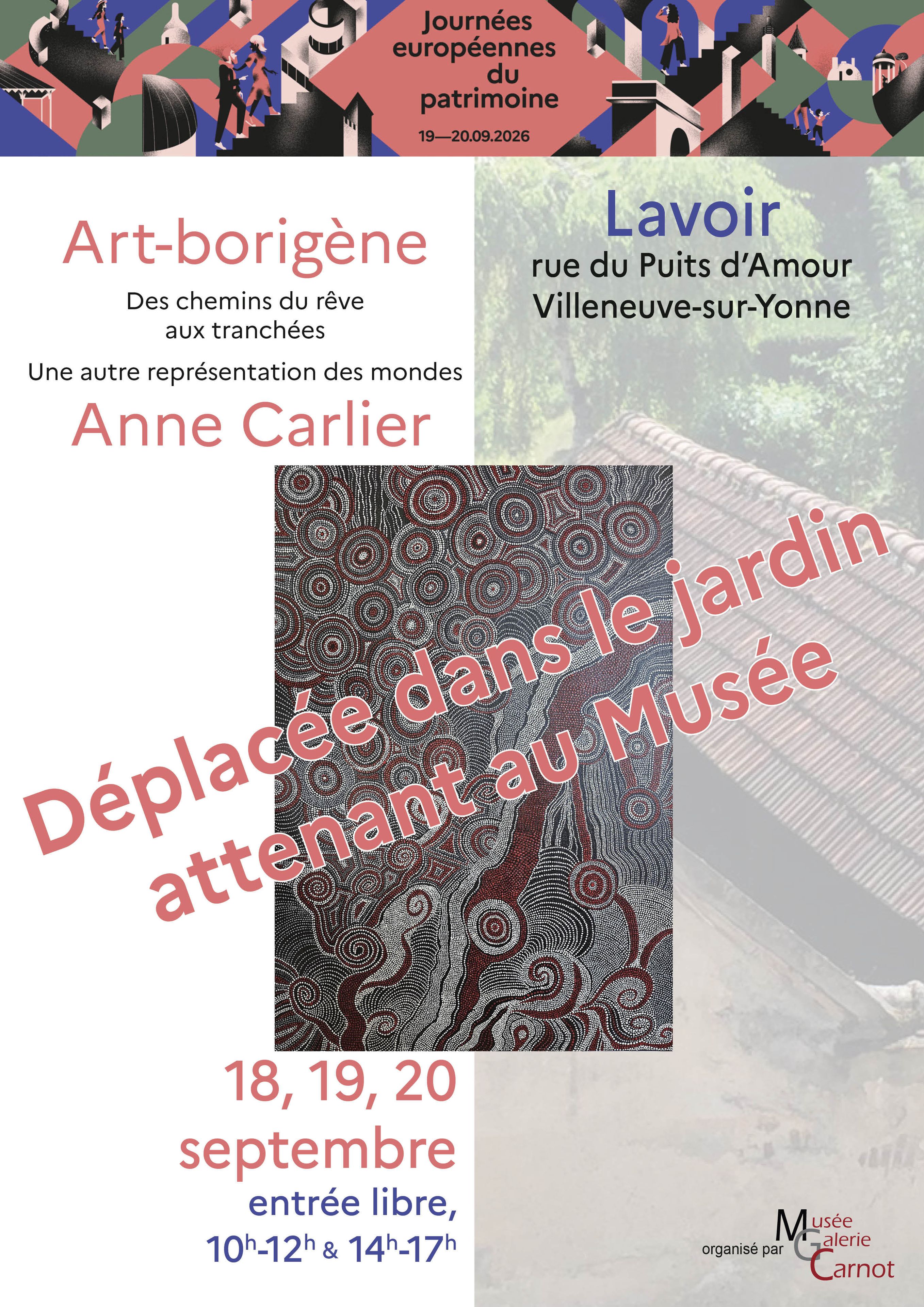
Exposition d'Anne Carlier, « Art-borigène», 𝐝𝐞́𝐩𝐥𝐚𝐜𝐞́𝐞 𝐝𝐚𝐧𝐬 𝐥𝐞 𝐣𝐚𝐫𝐝𝐢𝐧 d𝐮 𝐌𝐮𝐬𝐞́𝐞-𝐆𝐚𝐥𝐞𝐫𝐢𝐞 𝐂𝐚𝐫𝐧𝐨𝐭
Le _Dream land_ forme un réseau invisible qui couvre toute l’Australie. Les aborigènes célèbrent, chantent, dansent, miment et peignent (ce qui pour eux est avant tout un acte spirituel) ces Chemins …
© Musée Galerie Carnot LBS
𝐀𝐭𝐭𝐞𝐧𝐭𝐢𝐨𝐧 𝐞𝐱𝐩𝐨𝐬𝐢𝐭𝐢𝐨𝐧 𝐝𝐞𝐩𝐥𝐚𝐜𝐞𝐞 𝐝𝐚𝐧𝐬 𝐥𝐞 𝐣𝐚𝐫𝐝𝐢𝐧 𝐚𝐭𝐭𝐞𝐧𝐚𝐧𝐭 𝐚𝐮 𝐌𝐮𝐬𝐞𝐞-𝐆𝐚𝐥𝐞𝐫𝐢𝐞 𝐂𝐚𝐫𝐧𝐨𝐭
Le Dream land forme un réseau invisible qui couvre toute l’Australie. Les aborigènes célèbrent, chantent, dansent, miment et peignent (ce qui pour eux est avant tout un acte spirituel) ces Chemins du Rêve. Ils incarnent ainsi l’esprit ancestral créateur du lieu (dans son acception première et topographique), réactivant l’énergie créatrice tutélaire. Ces peinture sont entretenues afin de conserver l’énergie et la magie des lieux sacrés, pour que la vie puisse continuer sur terre. Elles tissent et rendent visibles lors de cérémonies religieuses pour initiés, les liens invisibles qui relient humains, animaux, plantes pour composer un univers harmonieux et durable.
Anne Carlier découvre l’Art Aborigène lors d’une exposition au centre culturel de l’Abbaye de Saint-Riquier, dans la Somme. Elle est fascinée par ce monde de lumière, couleurs, et de vibrations.
Loin de l’appropriation culturelle, elle réinterprète ce language intime aux paysages qui l’entourent, mêlant histoire, géographie et art, dans des toiles qui rendent palpables l’histoire des guerres mondiales notammant la première qui se sont inscrites dans la terre de Picardie.
Elle aborde aujourd’hui au delà des toiles les supports végétaux, principalement le palmier (écorces, tiges de feuilles) car le traditionnel eucalyptus est trop rare sous nos climats et minéraux.
Exposición de Anne Carlier, «Art-borigène», trasladada en el jardín de Museo-Galería Carnot
La _tierra de los sueños_ forma una red invisible que cubre toda Australia. Los aborígenes celebran, cantan, bailan, imitan y pintan (lo que para ellos es ante todo un acto espiritual) estos Caminos .
© Musée Galerie Carnot LBS
Atención exposición descolocado en el jardín Relacionado au Museo-Galería Carnot
El Tierra de sueños forma una red invisible que cubre toda Australia. Los aborígenes celebran, cantan, bailan, imitan y pintan (lo que para ellos es ante todo un acto espiritual) estos Caminos del Sueño. Encarnan así el espíritu ancestral creador del lugar (en su acepción primera y topográfica), reactivando la energía creadora tutelar. Estas pinturas son mantenidas para conservar la energía y la magia de los lugares sagrados, para que la vida pueda continuar en la tierra. Tejen y hacen visibles durante ceremonias religiosas para iniciados, los lazos invisibles que unen a humanos, animales y plantas para componer un universo armonioso y duradero.
Anne Carlier descubre el arte aborigen durante una exposición en el centro cultural de la Abadía de Saint-Riquier, en el departamento del Somme. Está fascinada por este mundo de luz, colores y vibraciones.
Lejos de la apropiación cultural, reinterpreta este lenguaje íntimo a los paisajes que lo rodean, mezclando historia, geografía y arte, en pinturas que hacen palpable la historia de las guerras mundiales, destacando la primera que se inscribió en la tierra de Picardía.
Hoy aborda, más allá de las telas, los soportes vegetales, principalmente la palma (corteza, tallos de hojas) porque el tradicional eucalipto es demasiado raro en nuestros climas y minerales.

