Workshop zur Erstellung von Cyanotypien-Bildern "Wo bleibt das Licht"
Zyanotyp-Workshop _Wo bleibt das Licht?
Samedi 19 septembre, 10h00
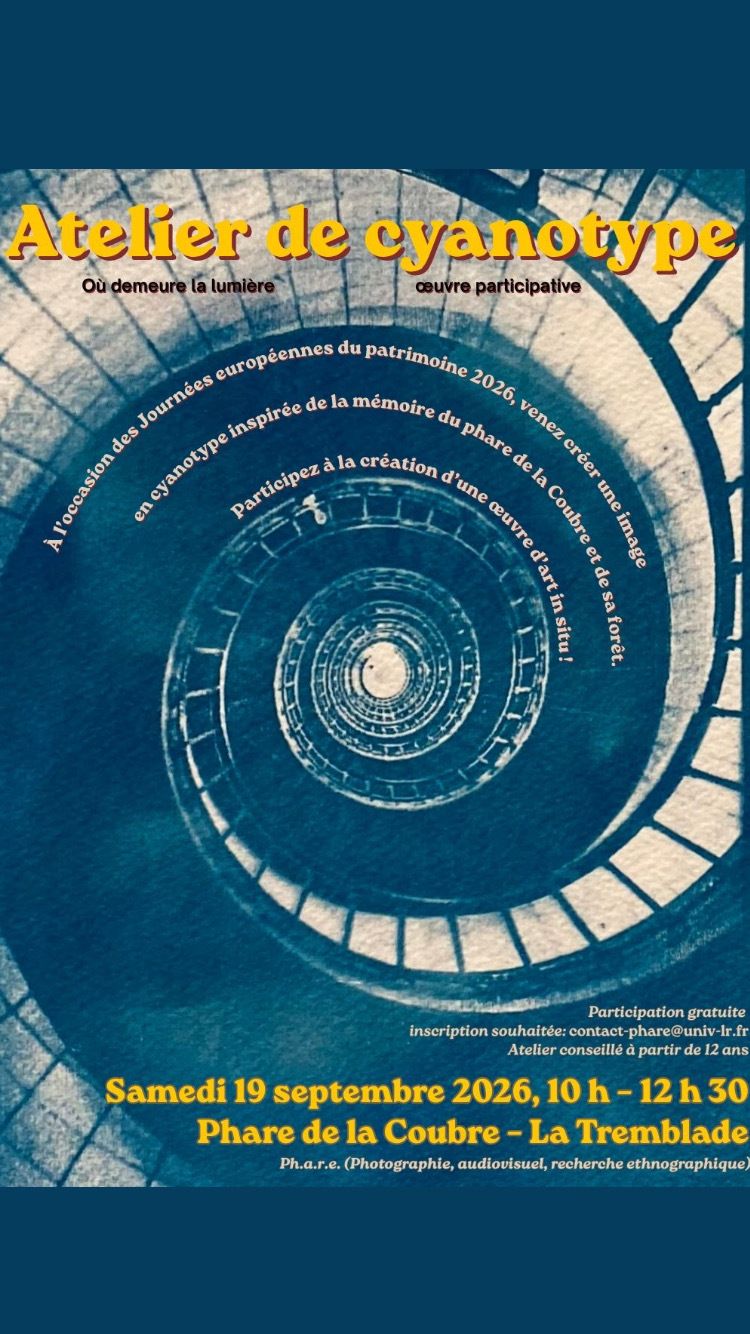
©Mattia Valentini
Zyanotyp-Workshop _Wo bleibt das Licht?
Im Rahmen des Ph.a.r.e. -Projekts (https://lienss.univ-larochelle.fr/Ph-a-r-e) und anlässlich der European Heritage Days 2026, Erstellen Sie ein Cyanotyp-Bild, das von der Erinnerung an den Leuchtturm von Coubre und seinen Wald inspiriert ist, und beteiligen Sie sich an der Schaffung eines Kunstwerks in situ.
Gratisteilnahme, Anmeldung gewünscht: contact-phare@univ-lr.fr
Im Rahmen des Projekts Ph.a.r.e. (Fotografie, audiovisuelle, ethnographische Forschung) wird das Werk Wo bleibt das Licht geschaffen und am 19. und 20. September 2026 vom Fotografen Mattia Valentini und der Anthropologin Cecilia Paradiso präsentiert. Anlässlich der Europäischen Tage des Kulturerbes wird das Werk auf dem Gelände des Leuchtturms von La Coubre im ehemaligen Garten des Leuchtturmwärters am Fuße der Düne stattfinden: diesem intimen Raum, der die Erinnerung an das tägliche Leben im Leuchtturm bewahrt. ist heute ein Observatorium der Bewegung des Dünensystems.
Diese Kreation ist das Ergebnis einer seit Februar 2026 durchgeführten Forschung zu den Verbindungen und Erinnerungen, die mit dem Leuchtturm und dem Wald von Coubre verbunden sind. Sie wird Fotografien, Erzählungen, alte Postkarten, Zeichnungen und Zeugnisse sammeln, die bei den Teilnehmern dieser Forschungsphase gesammelt wurden. Diese Elemente werden in Dialog mit natürlichen Materialien, die aus dem Meer und dem Wald stammen, und mit den Ergebnissen des partizipativen Cyanotype-Workshops gebracht.
Dieser Workshop lädt die Öffentlichkeit ein - ob sie an den ersten Phasen der Sammlung teilgenommen hat oder bei dieser Gelegenheit dem Projekt beigetreten ist -, sich an diesem kollektiven Schaffen zu beteiligen und dazu beizutragen, die Emotionen und Erinnerungen zu teilen, die mit diesen sich ständig verändernden Orten und Umgebungen verbunden sind. Die Teilnehmer können ein Bild im Cyanotyp erstellen und wählen, ob sie es entweder in das Werk integrieren möchten, das im Freien bleibt und der Wirkung der Elemente ausgesetzt ist, oder es am Ende des Workshops mitnehmen, um daraus eine neue Spur von Erinnerung und Bindung zu machen. Die Wahl des Cyanotypus - mit seinen Zeitvorstellungen und seiner Einfachheit - eröffnet so einen Raum der kreativen Teilnahme und der Begegnung mit den natürlichen und menschlichen Elementen des Ortes, von der Sonne bis zu den Blautönen der Opaline des Leuchtturms.
Samstag, 19. September 2026
10:00 - 12:30
Leuchtturm von La Coubre - La Tremblade
Gratisteilnahme, Anmeldung gewünscht: contact-phare@univ-lr.fr
Workshop empfohlen ab 12 Jahren
Der Cyanotyp
Cyanotypie ist ein altes fotografisches Verfahren, das Sonnenlicht verwendet. Einfach, sicher und für alle zugänglich, ermöglicht sie wunderschöne Bilder von tiefem Blau.
Die Teilnehmer können ihren eigenen Cyanotyp erstellen:
- aus Bildern, die in den letzten Monaten im Rahmen des Forschungsprojekts gesammelt wurden;
- oder unter Verwendung natürlicher Elemente (Blätter, Blumen, Kräuter, Algen, Federn...). Wenn Sie mit dieser Technik experimentieren möchten, zögern Sie nicht, die gesammelten Informationen mitzubringen.
Mit:
Cecilia Paradiso, Anthropologe - Universität von La Rochelle / LIENSs (https://lienss.univ-larochelle.fr/Paradiso-Cecilia)
Mattia Valentini, Künstler und Fotograf (https://www.mattiavalentini.org)
Mit der Unterstützung von:
Universität La Rochelle - Ethnopôle Humanités océanes - Labor LIENSs.
Diese Arbeit hat von einer staatlichen Unterstützung profitiert, die von der Agence Nationale de la Recherche im Rahmen des Plans France 2030 unter der Referenz ANR-21-EXES-0010 verwaltet wird.
In Zusammenarbeit mit:
Das Ökomuseum des Leuchtturms von La Coubre, das Schifffahrtsmuseum von La Rochelle, die Médiathèque Henri Moreau de La Tremblade, der audiovisuelle Forschungsfonds
Workshop for creating images in cyanotype "Where does the light remain"
Cyanotype_workshop where the light remains
Samedi 19 septembre, 10h00
©Mattia Valentini
Cyanotype_workshop where the light remains
As part of the project Ph.a.r.e. (https://lienss.univ-larochelle.fr/Ph-a-r-e>) and on the occasion of European Heritage Days 2026, come create a cyanotype image inspired by the memory of the La Coubre lighthouse and its forest, and participate in the creation of an artwork in situ.
Free participation, registration required: contact-phare@univ-lr.fr
As part of the project Ph.a.r.e. (Photography, audiovisual, ethnographic research), the work Where Light Dwells will be created and presented on September 19 and 20, 2026 by photographer Mattia Valentini and anthropologist Cecilia Paradiso. On the occasion of the European Heritage Days, on the site of the La Coubre lighthouse, the work will take place in the former lighthouse keeper’s garden at the foot of the dune: this intimate space, which preserves the memory of daily life at the lighthouse, is today an observatory of the movement of the dune system.
This creation is the result of research conducted since February 2026 around the links and memories associated with the lighthouse and the forest of the Coubre. It will bring together photographs, stories, ancient postcards, drawings and testimonies collected from participants in this research phase. These elements will be put in dialogue with natural materials, from the sea and the forest, and with the achievements resulting from the participatory workshop of cyanotype.
This workshop invites the public—whether they have participated in the first phases of collection or join the project on this occasion—to take part in this collective creation by contributing to the sharing of emotions and memories related to these constantly evolving places and environments. Participants will be able to create an image in cyanotype and choose either to integrate it into the work, which will remain outdoors, exposed to the action of the elements, or to take it away at the end of the workshop, to make a new trace of memory and attachment. The choice of the cyanotype—with its temporalities and simplicity—thus opens up a space for creative participation and encounter with the natural and human elements of the site, from the sun to the shades of blue of the opalines of the lighthouse.
Saturday, September 19, 2026
10 a.m. – 12:30 p.m.
La Coubre Lighthouse – La Tremblade
Free participation, registration required: contact-phare@univ-lr.fr
Workshop recommended from 12 years old
The cyanotype
Cyanotype is an ancient photographic process that uses sunlight. Simple, safe and accessible to everyone, it allows you to obtain beautiful images of a deep blue.
Participants will be able to carry out their cyanotype:
- from images collected over the past few months as part of the research project;
- or by using natural elements (leaves, flowers, herbs, algae, feathers...). If you want to experiment with this technique, do not hesitate to bring the elements that you will have collected.
With:
Cecilia Paradiso, anthropologist – University of La Rochelle / LIENSs (https://lienss.univ-larochelle.fr/Paradiso-Cecilia)
Mattia Valentini, artist and photographer (https://www.mattiavalentini.org)
With the support of:
La Rochelle University – Ethnopôle Humanités océanes – LIENSs laboratory.
This work received state aid managed by the National Research Agency under the France 2030 Plan, bearing reference ANR-21-EXES-0010.
In collaboration with:
The Écomusée du Phare de la Coubre · The Maritime Museum of La Rochelle · The Henri Moreau Multimedia Library of La Tremblade · The Audiovisual Research Fund
Laboratorio di creazione di immagini in cianotipo "Dove sta la luce"
Workshop di cianotipo _Dove rimane la luce
Samedi 19 septembre, 10h00
©Mattia Valentini
Workshop di cianotipo _Dove rimane la luce
Nell'ambito del progetto Ph.a.r.e. (https://lienss.univ-larochelle.fr/Ph-a-r-e) e in occasione delle Giornate europee del patrimonio 2026, Venite a creare un'immagine in cianotipo ispirata alla memoria del faro della Coubre e della sua foresta, e partecipate alla creazione di un'opera d'arte in situ.
Partecipazione gratuita, iscrizione desiderata: contact-phare@univ-lr.fr
Nell'ambito del progetto Ph.a.r.e. (Fotografia, audiovisivo, ricerca etnografica), l'opera Dove rimane la luce sarà realizzata e presentata il 19 e 20 settembre 2026 dal fotografo Mattia Valentini e dall'antropologa Cecilia Paradiso. In occasione delle Giornate europee del patrimonio, sul sito del faro della Coubre, l'opera avrà luogo nell'antico giardino del guardiano del faro, ai piedi della duna: questo spazio intimo, che conserva la memoria della vita quotidiana al faro, è oggi un osservatorio del movimento del sistema dunare.
Questa creazione è il risultato di una ricerca condotta dal febbraio 2026 sui legami e i ricordi associati al faro e alla foresta della Coubre. Raccoglierà fotografie, racconti, cartoline antiche, disegni e testimonianze raccolte presso i partecipanti a questa fase di ricerca. Questi elementi saranno messi in dialogo con materiali naturali, provenienti dal mare e dalla foresta, e con le realizzazioni derivanti dal workshop partecipativo di cyanotype.
Questo workshop invita il pubblico - che abbia partecipato alle prime fasi di raccolta o che si unisca al progetto in questa occasione - a prendere parte a questa creazione collettiva contribuendo alla condivisione delle emozioni e delle memorie legate a questi luoghi e ambienti in continua evoluzione. I partecipanti potranno realizzare un'immagine in cianotipo e scegliere se inserirla nell'opera, che rimarrà all'aperto, esposta all'azione degli elementi, oppure portarla alla fine del workshop, per farne una nuova traccia di memoria e di attaccamento. La scelta del cianotipo - con le sue temporalità e semplicità - apre così uno spazio di partecipazione creativa e di incontro con gli elementi naturali e umani del sito, dal sole alle sfumature di blu delle opaline del faro.
Sabato 19 settembre 2026
10.00 - 12.30
Faro di La Coubre - La Tremblade
Partecipazione gratuita, iscrizione desiderata: contact-phare@univ-lr.fr
Workshop consigliato a partire dai 12 anni
Il cianotipo
Il cianotipo è un antico processo fotografico che utilizza la luce solare. Semplice, sicuro e accessibile a tutti, permette di ottenere immagini magnifiche di un blu profondo.
I partecipanti potranno realizzare il loro cyanotype:
- dalle immagini raccolte negli ultimi mesi nell'ambito del progetto di ricerca;
- o utilizzando elementi naturali (foglie, fiori, erbe, alghe, piume...). Se desiderate sperimentare questa tecnica, non esitate a portare gli elementi che avrete raccolto.
Con:
Cecilia Paradiso, antropologa - Università di La Rochelle / LIENSshttps://lienss.univ-larochelle.fr/Paradiso-Cecilia)
Mattia Valentini, artista e fotografo (https://www.mattiavalentini.org)
Con il supporto di:
Università di La Rochelle - Ethnopôle Humanités océanes - laboratorio LIONS.
Questo lavoro ha beneficiato di un aiuto dello Stato gestito dall'Agenzia nazionale della ricerca nell'ambito del Piano Francia 2030, con il riferimento ANR-21-EXES-0010.
In collaborazione con:
L'Ecomuseo del Phare de la Coubre Il Museo marittimo di La Rochelle La Médiathèque Henri Moreau de La Tremblade Il Fondo audiovisivo di ricerca
Atelier de création d'images en cyanotype "Où demeure la lumière"
Atelier de cyanotype\_Où demeure la lumière
Samedi 19 septembre, 10h00
©Mattia Valentini
Atelier de cyanotype_Où demeure la lumière
Dans le cadre du projet Ph.a.r.e. (https://lienss.univ-larochelle.fr/Ph-a-r-e) et à l’occasion des Journées européennes du patrimoine 2026, venez créer une image en cyanotype inspirée de la mémoire du phare de la Coubre et de sa forêt, et participez à la création d’une œuvre d’art in situ.
Participation gratuite, inscription souhaitée: contact-phare@univ-lr.fr
Dans le cadre du projet Ph.a.r.e. (Photographie, audiovisuel, recherche ethnographique), l’œuvre Où demeure la lumière sera créée et présentée les 19 et 20 septembre 2026 par le photographe Mattia Valentini et l’anthropologue Cecilia Paradiso. À l’occasion des Journées européennes du patrimoine, sur le site du phare de la Coubre, l’oeuvre prendra place dans l’ancien jardin du gardien du phare, au pied de la dune : cet espace intime, qui conserve la mémoire de la vie quotidienne au phare, est aujourd’hui un observatoire du mouvement du système dunaire.
Cette création est le fruit d’une recherche menée depuis février 2026 autour des liens et des souvenirs associés au phare et à la forêt de la Coubre. Elle rassemblera des photographies, des récits, des cartes postales anciennes, des dessins et des témoignages collectés auprès des participant·es à cette phase de recherche. Ces éléments seront mis en dialogue avec des matériaux naturels, issus de la mer et de la forêt, et avec les réalisations issues de l’atelier participatif de cyanotype.
Cet atelier invite le public — qu’il ait participé aux premières phases de collecte ou qu’il rejoigne le projet à cette occasion — à prendre part à cette création collective en contribuant au partage des émotions et des mémoires liées à ces lieux et milieux en constante évolution. Les participant·es pourront réaliser une image en cyanotype et choisir soit de l’intégrer à l’œuvre, qui demeurera en plein air, exposée à l’action des éléments, soit de l’emporter à la fin de l’atelier, pour en faire une nouvelle trace de mémoire et d’attachement. Le choix du cyanotype — avec ses temporalités et sa simplicité — ouvre ainsi un espace de participation créative et de rencontre avec les éléments naturels et humains du site, du soleil aux nuances de bleu des opalines du phare.
Samedi 19 septembre 2026
10 h – 12 h 30
Phare de La Coubre – La Tremblade
Participation gratuite, inscription souhaitée: contact-phare@univ-lr.fr
Atelier conseillé à partir de 12 ans
Le cyanotype
Le cyanotype est un ancien procédé photographique qui utilise la lumière du soleil. Simple, sans danger et accessible à toutes et tous, elle permet d’obtenir de magnifiques images d’un bleu profond.
Les participant·es pourront réaliser leur cyanotype :
- à partir d’images collectées au cours des derniers mois dans le cadre du projet de recherche ;
- ou en utilisant des éléments naturels (feuilles, fleurs, herbes, algues, plumes…). Si vous souhaitez expérimenter cette technique, n’hésitez pas à apporter les éléments que vous aurez récoltés.
Avec :
Cecilia Paradiso, anthropologue – Université de La Rochelle / LIENSs (https://lienss.univ-larochelle.fr/Paradiso-Cecilia )
Mattia Valentini, artiste et photographe (https://www.mattiavalentini.org )
Avec le soutien de :
La Rochelle Université – Ethnopôle Humanités océanes – laboratoire LIENSs.
Ce travail a bénéficié d'une aide de l’État gérée par l'Agence Nationale de la Recherche au titre du Plan France 2030, portant la référence ANR-21-EXES-0010.
En collaboration avec :
L'Écomusée du Phare de la Coubre · Le Musée maritime de La Rochelle · La Médiathèque Henri Moreau de La Tremblade · Le Fonds Audiovisuel de Recherche
Taller de creación de imágenes en cianotipo "Donde reside la luz"
Taller de cianotipe_Por donde permanece la luz
Samedi 19 septembre, 10h00
©Mattia Valentini
Taller de cianotipe_Por donde permanece la luz
Como parte del proyecto Ph.a.r.e. (https://lienss.univ-larochelle.fr/Ph-a-r-e) y con motivo de las Jornadas europeas del patrimonio 2026, Ven a crear una imagen en cianotipo inspirada en la memoria del faro de la Coubre y su bosque, y participa en la creación de una obra de arte in situ.
Participación gratuita, inscripción deseada: contact-phare@univ-lr.fr
En el marco del proyecto Ph.a.r.e. (Fotografía, audiovisual, investigación etnográfica), la obra Où demeure la lumière será creada y presentada los días 19 y 20 de septiembre de 2026 por el fotógrafo Mattia Valentini y la antropóloga Cecilia Paradiso. Con motivo de las Jornadas Europeas del Patrimonio, en el sitio del faro de la Coubre, la obra ocupará su lugar en el antiguo jardín del guardián del faro, al pie de la duna: este espacio íntimo que conserva la memoria de la vida cotidiana en el faro, es hoy un observatorio del movimiento del sistema de dunas.
Esta creación es el resultado de una investigación llevada a cabo desde febrero de 2026 en torno a los vínculos y recuerdos asociados con el faro y el bosque del Coubre. Reunirá fotografías, relatos, postales antiguas, dibujos y testimonios recogidos de los participantes en esta fase de investigación. Estos elementos se pondrán en diálogo con materiales naturales, procedentes del mar y del bosque, y con las realizaciones resultantes del taller participativo de cianotipo.
Este taller invita al público -ya haya participado en las primeras fases de la colecta o se una al proyecto en esta ocasión- a participar en esta creación colectiva contribuyendo al intercambio de emociones y recuerdos relacionados con estos lugares y entornos en constante evolución. Los participantes podrán realizar una imagen en cianotipo y elegir entre incorporarla a la obra, que permanecerá al aire libre, expuesta a la acción de los elementos, o llevarla al final del taller, para hacer de ella un nuevo rastro de memoria y apego. La elección del cianotipo -con sus temporalidades y su simplicidad- abre así un espacio de participación creativa y de encuentro con los elementos naturales y humanos del lugar, desde el sol hasta las tonalidades de azul de las opalinas del faro.
Sábado, 19 de septiembre de 2026
10.00 a 12.30 horas
Faro de La Coubre - La Tremblade
Participación gratuita, inscripción deseada: contact-phare@univ-lr.fr
Taller recomendado a partir de los 12 años
El cianotipo
El cianotipo es un antiguo proceso fotográfico que utiliza la luz solar. Sencilla, segura y accesible para todos, permite obtener imágenes magníficas de un azul profundo.
Los participantes podrán realizar su cianotipo:
- a partir de imágenes recogidas durante los últimos meses en el marco del proyecto de investigación;
- o utilizando elementos naturales (hojas, flores, hierbas, algas, plumas...). Si desea experimentar con esta técnica, no dude en traer los datos que haya recogido.
Con:
Cecilia Paradiso, antropóloga - Universidad de La Rochelle / LIENSs (https://lienss.univ-larochelle.fr/Paradiso-Cecilia)
Mattia Valentini, artista y fotógrafo (https://www.mattiavalentini.org)
Con el apoyo de:
Universidad de La Rochelle - Etnopôle Humanidades Oceánicas - laboratorio LENS.
Este trabajo se ha beneficiado de una ayuda del Estado gestionada por la Agencia Nacional de Investigación en virtud del Plan Francia 2030, con la referencia ANR-21-EXES-0010.
En colaboración con:
El Ecomuseo del Faro de la Coubre El Museo Marítimo de La Rochelle La Médiathèque Henri Moreau de La Tremblade El Fondo Audiovisual de Investigación

